
“Some of what would appear to be ‘basic systematic processing’ is really intended to simply get a Seeker to actually recognize the facets associated with these various areas that have contributed to holding them back from the full realization of Self, in Self-Honesty, free of fragmentation, compulsion and inhibition.…”
—Joshua Free, PC-8, Conquest of Illusion and Pathway to Ascension (Vol.1)
[This is the final blog-post article for this series, directly continuing from PART-6.]
Note that this article (Part-7) directly applies basic ‘systematic processing’ as a technique instructed by Mardukite Academy and Systemology Society. It is necessary to understand how to apply ‘systematic processing’ in order to achieve stable gains from these exercises. The basic instructions for ‘processing’ are introduced elsewhere – such as found in the “Fundamentals of Systemology” ‘new standard basic course’ BOOKS and/or VIDEOS. [A future series of blog-post articles is also intended to cover the basics of personal ‘systematic processing’.]

“As mentioned (in the previous part): most suppressive control is aimed at ‘stopping motion’ (or action). While there are ways of being constructively critical, most criticism is intended to reduce or ‘make nothing’ of another’s efforts or creations. The following basic processes will help in identifying these occurrences. We employ the word ‘spot’ (rather than ‘recall’) in these ‘processing command lines’ (PCL) to more accurately apply this processing to the full ‘Backtrack’.”
—Joshua Free, PC-8, Conquest of Illusion and Pathway to Ascension (Vol.1)
Analytical Defrag – STOPS
1. “Spot a time when you stopped someone.”
2. “Spot a time when someone stopped you.”
3. “Spot a time when someone stopped another (or others).”
0. “Spot a time when you stopped yourself.”
Analytical Defrag – CRITICISM
1. “Spot a time when you criticized someone.”
2. “Spot a time when someone criticized you.”
3. “Spot a time when someone criticized another (or others).”
0. “Spot a time when you criticized yourself.”
Analytical Defrag – INVALIDATION
1. “Spot a time when you ‘made nothing’ of someone.”
2. “Spot a time when someone ‘made nothing’ of you.”
3. “Spot a time when someone ‘made nothing’ of another (or others).”
0. “Spot a time when you ‘made nothing’ of yourself.”
“It is not uncommon to find that encounters with a very ‘suppressive-type’ during childhood can remain influential later on in life—even when that individual is no longer present. But that is how imprints work. When Solo-Processing the following exercise, use your notebook or Flight-log to record the data from each PCL-question. List multiple answers (if necessary) to make sure you have answered each fully.”
—Joshua Free, PC-8, Conquest of Illusion and Pathway to Ascension (Vol.1)
A. “Is there anyone around whom you seem to become ‘sick’ shortly after seeing them?”
B. “Is there anyone who is continuously critical of you?”
C. “Is there anyone who is often telling you how ‘bad’ other people are?”
D. “Is there anyone who continuously ‘stops’ you?”
E. “Is there anyone who continuously ‘invalidates’ you?”
F. “Is there anyone who often provides ‘false’ information?”
G. “Is there anyone who often ‘makes nothing’ of your efforts?”
If you find yourself writing the same name on several lists, then run the following processes using that name as the “terminal” (blank space) in the PCL (‘processing command lines’). If there are multiple names that frequently appear, then run those names as terminals too (each as their own series of processes).
There is no “judgment” applied here about someone else’s intentions toward us. The very fact that their name shows up frequently on these “lists” is sufficient to indicate there is enough charge present (as fragmentation) for that “suppressive terminal” (their name) to be run in processing.
“The following series of processes begins with a familiar one (from a previous professional course lesson) regarding ‘help’. The purpose is not to enforce actually helping someone, but to restore ‘free choice’ (that is not overridden by fragmentation). Considerations of ‘help’ also assist in breaking down barriers of negative reactive emotion, so that a Seeker is better able to actually ‘confront’ the true source of suppression ‘As-It-Is’...”
—Joshua Free, PC-8, Conquest of Illusion and Pathway to Ascension (Vol.1)
Suppressive Terminal – HELP
1. “How could you help —?”
2. “How could — help you?”
3A. “How could — help others?”
3B. “How could others help —?”
Suppressive Terminal – PROBLEMS
1A. “What ‘problem’ have you been to —?”
1B. “What have they done about that?”
2A. “What ‘problem’ has — been to you?”
2B. “What have you done about that?”
3A. “What ‘problem’ has — been to others?”
3B. “What have others done about that?”
4A. “What ‘problem’ have others been to —?”
4B. “What have they done about that?”
Suppressive Terminal – HOLD-OUTS
1. “What haven’t you said to —?”
2. “What hasn’t — said to you?”
3. “What hasn’t — said to others?”
Suppressive Terminal – ACTION
1. “What have you done to —?”
2. “What has — done to you?”
3A. “What has — done to others?”
3B. “What have others done to —?”
Suppressive Terminal – INVALIDATION
1. “How have you ‘invalidated’ —?”
2. “How has — ‘invalidated’ you?”
3A. “How has — ‘invalidated’ others?”
3B. “How have others ‘invalidated’ —?”
The basic instructions for ‘processing’ are introduced elsewhere – such as found in the “Fundamentals of Systemology” ‘new standard basic course’ BOOKS and/or VIDEOS.
[See the ‘New Standard Systemology’ professional course BOOKS and/or VIDEOS for additional ‘systematic processing’ techniques and exercises for handling this area.]
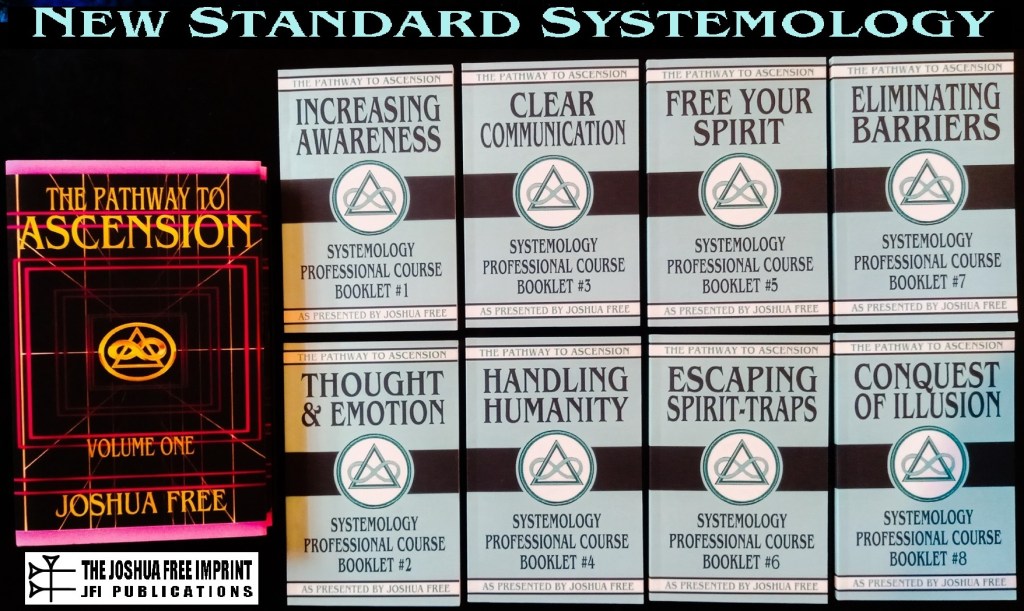
The complete ‘New Standard Systemology’ (Level 0 to 8) course is available in five hardcover anthologies or as 33 individual booklet-lessons, published by The Joshua Free Imprint (JFI Publications) and the Mardukite Academy.

































 * MARDUKITE ACADEMY OF SYSTEMOLOGY *