Category Archives: news

Sumerian Wisdom & Babylonian Cuneiform Tablets: Wisdom on Civil Disobedience, Submission & Defiance

2. “What is given in submission is a catalyst for defiance.” (1)

The ‘Near East’ of the ancient world, now called the ‘Middle East’ today, has never found an equilibrium of political or military peace. Imaginary borders and boundaries, not to mention total conquest of the Babylonian Empire, meant a king could be a true conqueror of the ‘known world’ and legitimately the most powerful of figures in its midst.

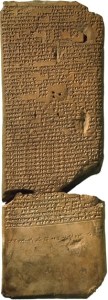
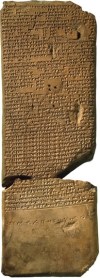
cuneisdgsdg nig-gu-gar-ra nig-gaba-gar-ra (2)
‘That which is given in submission becomes a medium of defiance.‘ (3)

When the annals of Mesopotamian history are examined, a seeker discovers a broad legacy of constantly shifting sands of power, dynastic reign and the geographical realm of an empire’s capital city all play a part in military management of these ancient forces that fought for control of the Tigris and Euphrates river valley (Mesopotamia), the resources it contained (abundant when tapped properly), the recognition of and authority over a sweeping population (the largest urban centers of the ancient world) and the state-religions governing the whole system (that have gone on to shape even the programming of the modern world).

sumlangthumb The actual cuneiform verse can be translated in two different ways. Both are meant to convey the same sentiment. Early transliteration scholars recognized that ‘gu-gar‘ and ‘gaba-gar‘ refer to ‘things’ of submission (gu-gar) and defiance (gaba-su-gar), which makes the statement we have above possible. However, if the ‘figure of speech’ is to be taken literally, then the ‘thing’ given is a “neck” (gu) beneath (“submission”) your opponents foot – or else, “sticking your neck out” – and this ‘thing’ becomes a ‘thing’ (placed) against the opponents chest, a sign of “defiance.” (7)

SUMERIAN VOCABULARY
[nig-] – a thing / ‘abstract’ (4)(7)
gu-gar – to submit / give submission (4)
gu – neck (5)
gaba-su-gar – of defiance / to defy (4)
gaba – chest / breast (4)
sajahafronthumb The cuneiform author suggests ‘taking one for the team’, giving motivational due to one who executes gainful sacrifice for a better future outcome – or, at least, the possibility of one. Considered in the spirit of ‘civil disobedience’ as suggested by classic writer, Henry David Thoreau, the advice may be for the ‘common folk’ rather than warlords and kings, and suggests that one keeps their head down in order to ‘fight another day’. (6)


(1) Translation of Sumerian Proverb tablet by Joshua Free for “Sumerian Wisdom II” materials, forthcoming sequel to “Sumerian Wisdom & Anunnaki Prophecies: The Book of Sajaha the Seer“ edited by Joshua Free. These tablets attempt to preserve Sumerian language proverbs in cuneiform script during the Old Babylonian period.
(2) Derived from the original “Sumerian Proverbs” collection found in Nippur by the University Museum of the University of Pennsylvania.
(3) Original translation provided in the “Sumerian Proverbs” museum monograph by Edmund Gordon.
(4) Vocabulary supplement derived from the ‘Sumerian Glossary and Concordance’ for the Gordon “Sumerian Proverbs” museum monograph.
(5) Vocabulary inclusion of student translation is derived from the Mardukite handbook: “Secrets of Sumerian Language“ edited by Joshua Free.
(6) As explained by Edmund Gordon, regarding ‘passive resistance’ alluded to in this tablet: “…the enemy will eventually be overthrown by means of whatever has been surrendered to him.”
(7) The Sumerian cuneiform prefixing sign ‘nig‘ – found at the start of lines throughout this particular series of ‘proverb’ tablets – indicates an attached statement regarding a ‘thing’ as an “abstraction” (concept) rather than always to be treated as a literal “thing” (object).

1 Comment

Filed under akkadian, ancient esoterica, ancient near east, babylonian, excerpt, mardukite, mesopotamian, new babylon, new release, news, nexgen, plans & proposals, research development, sumerian, truth seeker press

Sumerian Proverbs & Babylonian Wisdom: Ancient Cuneiform Tablets Reveal Emphasis on “Truth”

claytabletsheader

“Whoever partners with Truth, creates Life.” (1)

At the forefront of the ‘Sumerian Proverbs’ [Liber-P] Old Babylonian (Akkadian) cuneiform tablet series is a homage to the universal and ineffable spirit of Truth – that enigmatic force – a driving pursuit at the core of all language arts at the cradle of modern human civilization sciences…

cuneisdgsdg nig-ge-na-ta a-ba in-da-di nam-ti i-u-tu (2)

‘Whoever has walked with truth generates life.’ (3)

Communicating this philosophy to modern minds in English language is difficult. The sentiment carried is greater than to simply say: ‘whoever is true’ or ‘whoever is with truth’. It also does not say ‘whoever is filled with truth’. Whether we adopt the -da/-ta (together with) or -ta[b] (partnered with) interpretation, the implication is that ‘whoever’ is deeply ingrained or ‘bound’ to Truth; it is next to them, it is their companion, or else they have taken it as a friend, forsaking all others that might break that bond.

sumlangthumb I favor this preferred meaning over the original interpretation of having ‘walked with truth’ (impermanent past-tense). I understand the original author/translator meaning to imply the ‘walking with a companion’, but the interpretation seems vague if not misrepresenting the actual Sumerian Lexicon being evoked.

SUMERIAN VOCABULARY

[nig]-ge-na – truth (4)

-da/-ta – beside, in vicinity of, together with (5)

-ta[b] – friends, companion, partner (5)

a-ba – who? / whoever (5)

nam-ti – fate/nam; life/ti (5)

u-tu – to bear ‘children’, give birth to (5)

MesopotamianReligionFrontcrop Given that the word for ‘generating’ or ‘creating’ life given here is the same word meant to imply literal ‘birth-giving’, the romantic interpretation of this proverb is that ‘whoever partners with Truth as a lover’ will ‘give birth to Life’ – they will ‘radiate’ or ‘generate’ a prosperous life. The subject is not simply ‘building’ or ‘constructing’ the life out of preexisting materials but is literally ‘giving birth to’ their existence, life or reality as a result of their union with Truth – living in harmony with observed cosmic forces and thereby manifesting the desired life and result. (6)


(1) Translation of Sumerian Proverb tablet by Joshua Free for “Sumerian Wisdom II” [Liber P] materials, forthcoming sequel to “Sumerian Wisdom & Anunnaki Prophecies: The Book of Sajaha the Seer“ edited by Joshua Free, with translation assistance by Khem Juergen. These tablets attempt to preserve Sumerian language proverbs in Old Babylonian (Akkadian) cuneiform script.

(2) Derived from the original “Sumerian Proverbs” collection found in Nippur by the University of Pennsylvania, combined with lines 1-2 of the “GGG” tablet text (catalogue number U.17207-58) excavated from Ur and transliterated for the 1959 edition.

-GGG-

1. nig-ge-na-ta a-ba in-da-[DI]

2. nam-ti ia-u-t[u].

(3) Original translation provided in the “Sumerian Proverbs” museum monograph by Edmund Gordon.

(4) Vocabulary supplement derived from the ‘Sumerian Glossary and Concordance’ for the Gordon “Sumerian Proverbs” museum monograph.

(5) Vocabulary inclusion of student translation is derived from the Mardukite handbook: “Secrets of Sumerian Language“ edited by Joshua Free.

(6) As explained by Edmund Gordon: “…a man who lives in accord with the universally recognized ‘cosmic and immutable truths’ will be able to obtain for himself all the good things in life.”

1 Comment

Filed under akkadian, ancient esoterica, ancient near east, babylonian, excerpt, mardukite, mesopotamian, new babylon, new release, news, nexgen, plans & proposals, prophecies & predictions, research development, sumerian

A New Mesopotamia Born from Iraq: Babylon Rises Again! | Middle East News

Lamassu.Nabu_2

Thousands of years of political discord, dragon-fights between dynastic and royal bloodlines, new waves of Judeo-Christianity and Islam overshadow the previously observed traditions of the Anunnaki… A cradle of civilization, birthplace of systems and arts of humanity… Religion. Language. Politics. Mesopotamia – Land Between the Rivers – as it was once known from its Greek name; Iraq today, but what of tomorrow?

magansmall After years of the Piscean Age ruled by non-Babylonian Arabs and the near extinction of the Yezidi tribes, who will lay claims to the boundaries of Mesopotamia in a post-modern — post-Iraq — future ever changed by wars for oil, scarred by military from several nations, the rule of Saddam Hussein, and now the Islamic State? Where will the new political boundaries lie when the Middle East disbands and there becomes a New Mesopotamia between the Tigris and Euphrates? And who will be seated in New Babylon when the coming age arrives?

“The exact political boundaries of Babylonia are not generally agreed upon – no more today among scholars and nationalists then by those who physically fought for them in periods of antiquity. For as long as humans have been involved, the are has been plagued in constant conflict…”
— Joshua Free, Liber-51/52

…Mesopotamian territory often included areas outside the pathway of the two rivers, which even themselves changed positions over time with the alteration and then absence of human intervention via the aqueduct canal systems (and other natural occurrences).

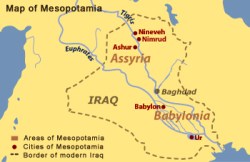
MesopotamianReligionFrontcrop By today’s standards the “Middle East” or “Ancient Near East” includes the geographical locations occupied as Iran, Iraq, Saudi Arabia, Yemen, Oman, Lebanon, Israel, Syria and the United Arab Emirates.

Mesopotamian kingdoms also included (at some time or another) occupations in modern-day Turkey, Armenia, Afghanistan, Pakistan, Egypt and Sudan. The term “Middle East” is a modern Euro-centric semantic replacing the academic usage of the ‘Near East’ (as opposed to the ‘Far East’ or “oriental”).

With few exceptions, the Middle East and its ancient Anunnaki legacy is the origin of most major world religions in history including Zoroastrianism (Mazdaism), Mithraism, Canaanite, Yezidism (Yazdanism), the Baha’i Faith, Manichaeism (Mandaeism), Islam (Muslim), Judaism and Christianity!

mesopotamia_map The overt evolution of the Sumerians into a Babylonian Empire is not altogether surprising – on the surface. However, the seeker should keep in perspective just how quickly all of this developed from seemingly nothing. It is true that societal living was originally organized around state religion, but prior to this it was culminated not by the social relationships shared between people, but by their living relationship with the earth.

Where first we have loosely organized nomadic hunter-gatherers that are forced to wander about or dwell in caves, essentially rolling the dice of chance for their survival, very little time passes before the sweeping transition in Mesopotamia toward planned agricultural farming and pasturing shepherds.

cuneisdgsdg Credited with many ‘firsts’ in the development of human history, it is the incorporation and evolution of cuneiform ‘writing’ that the Sumerians can be esteemed for – something which was undoubtedly entirely necessary for the civic growth of the human world.

In fact, it is only with ‘writing‘ that we have any concept at all of the history of humanity; everything prior to this inception, is rightfully considered ‘prehistoric’, at least by ‘modern’ standards.

According to ancient cuneiform tablets, the decision to cultivate civilization in the Middle East was not of men, but of a genetically distinct race known as the Anunnaki – those that appeared to ‘come down from the sky’ and were later called the gods of the original ‘pantheon’ of deities on earth…

3 Comments

Filed under akkadian, ancient near east, assyrian, babylonian, excerpt, mardukite, mesopotamian, new babylon, new release, news, nexgen, plans & proposals, prophecies & predictions, research development, sumerian, truth seeker press, youtube